Method FOMO: Why Companies Chase Every New Framework

Companies chase every new framework because uncertainty and the sight of competitors reward imitation long before a benefit is proven. Method FOMO is a serious leadership issue, since every rollout ties up capacity and management attention. Leaders who answer seven questions before deciding turn the pressure into a reasoned choice and settle which framework fits their own operation and which does not.
This article explains where the pressure comes from, what organisational research says about it, what a change of framework really costs and how to reach a decision that withstands questions from the board of management, shareholders or staff. The pressure is legitimate: competitors publish case reports, conferences present new frameworks, and employees bring vocabulary from previous employers.
Where does method FOMO come from?
Method FOMO has three sources: uncertainty about the right path, visible success stories from other companies, and the expectation that leadership has an answer to every new development. Organisational sociology has described this since 1983. In “The Iron Cage Revisited”, DiMaggio and Powell show that organisations under uncertainty tend to imitate successful models. They call this mimetic isomorphism: those who do not know which solution works copy the one that seems to work elsewhere. In 1996 Abrahamson described in the Academy of Management Review how management fashions arise: consultants, management gurus, publishers and business schools create demand for novelty, and executives adopt whatever counts as progressive.
Psychology has studied fear of missing out as a construct. In 2013 Przybylski and colleagues described in a study the motives behind the fear of missing something and its consequences. In companies the same dynamic operates: when a competitor adopts a framework, leadership worries about missing something that will later translate into an advantage. The question of what the framework actually changed there is rarely asked, because the answer is laborious to obtain and the rollout itself already counts as success.
The number of methods has also grown. The Agile Manifesto of 2001 set out four values and twelve principles and prescribed no method. In the years since, SAFe, LeSS, Disciplined Agile and the so-called Spotify model joined Scrum and Kanban, followed later by Team Topologies, Shape Up and Flight Levels. Each answers a particular problem. The variety gives leadership a real choice but overwhelms it without criteria.
What does it cost to follow every framework?
Every rollout costs three things: the time of those involved, the confusion of changing terminology and trust in the next change. The time can be estimated. A framework that prescribes roles, events and planning rhythms ties up weeks in each affected team for training, tool changes and practising the routines, and delivery performance dips during that period. A switch from one framework to the next repeats the phase, and teams have barely absorbed the old way of working when the new one begins.
The second item is harder to quantify. When employees experience their third method in three years, they learn that change is a matter of the moment, and they wait it out. The articles on agile rituals without effect and Scrum in medium-sized companies describe how rituals continue after their purpose has been forgotten. Method FOMO strengthens the effect, because each new wave covers the ritual of the last without clarifying it.
The third item concerns leadership. A management team that follows every fashion loses the ability to explain why a particular method applies in the business. Those who cannot justify it to shareholders or department heads have no argument at the next change.
How do you tell a fitting framework from a fashionable one?
A framework fits when it solves a problem the business demonstrably has and when its prerequisites exist in the company. Every framework arose in a context. Scrum was developed for teams that build a product in stages. Team Topologies by Skelton and Pais describes how companies cut teams along the flow of work and which communication paths they need for that. Shape Up from Basecamp relies on fixed six-week cycles for shaped projects. Basecamp's context, a product with a small team, differs from that of a corporation with hundreds of people involved, and decision-makers should say so before transferring a framework.
The Spotify model shows the risk of transfer. In a 2012 white paper, Kniberg and Ivarsson described how Spotify organised its teams in squads, tribes, chapters and guilds, and explicitly called it a snapshot. Many companies nonetheless read it as a recipe. The article on Team Topologies shows, by contrast, how a framework builds the teams' context explicitly into the decision.
Seven test questions before introducing a framework
Seven questions turn the impulse into a decision when management and business units answer them together. Anyone unable to answer one has not yet prepared the decision.
- Which problem in the business should the framework solve, and how is it measured today? A problem such as “deliveries are on average three weeks late” can be tested; “we want to become more agile” cannot.
- For which context was the framework developed, and how similar is your own? The primary source answers this, for example the 2020 Scrum Guide, the Kanban Guide or the book on Team Topologies.
- Which prerequisites does it demand, and are they in place? Examples are a Product Owner with decision rights or teams that own a result from start to finish.
- What changes for roles, budgets and reporting lines, and who must agree? A framework that shifts decision rights needs the agreement of the management level that gives them up.
- Which existing practice does it replace, and what happens to it? Those who only add create duplicate work.
- How can the rollout be tested on a limited scale? A pilot with one or two teams over three months delivers data before the company commits.
- How will we see after 90 days that it works, and what is the stopping point? Without a stopping criterion every rollout becomes a permanent task.
The questions tie the choice to the business outcome. They protect against adopting a framework that merely sounds good and against rejecting one that fits because it looks too new.
How should management respond to outside pressure?
Management responds best to outside pressure with a procedure that treats every request alike. A shareholder who asks why the company does not use SAFe receives an answer drawn from the seven questions, naming the problem, the context and the prerequisites. The answer may be that SAFe targets programmes of 50 to 125 people and the business unit consists of four teams. It may also be that one part of the framework, such as joint planning across several teams, deserves a pilot. The article on agile coaches describes how outside support can be used so that knowledge stays in the company.
A fixed rhythm helps. The company collects new frameworks and requests over the quarter and assesses them once, together, instead of reacting to each suggestion. The decision is minuted and given a baseline, so that after a year it is clear what was chosen and why.
Choosing a method with Niehues Consulting
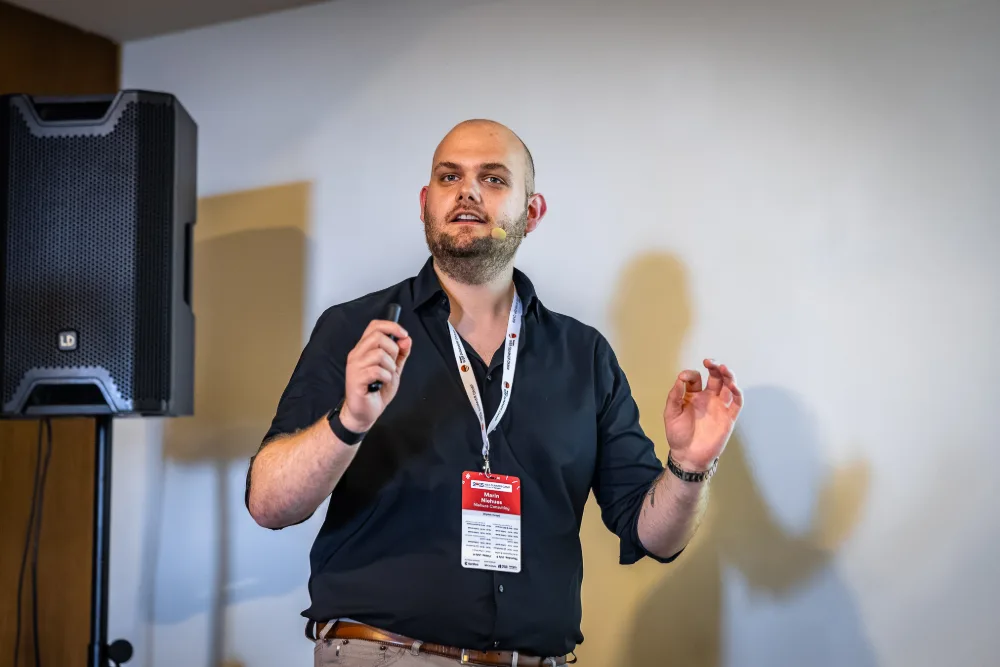
Niehues Consulting is a consultancy for AI management and organisational design from the delivery perspective, based in Düsseldorf. Founder Marin Niehues builds organisations that deliver, in projects from VC-funded scale-ups to DAX 40 corporations and in more than 20 countries on six continents. In the delivery management and organisational design service he examines which way of working suits which kind of work, and introduces it with clear roles and decision paths.
The approach follows the Niehues Delivery Model. Three of its test questions count for the question of which framework a company needs: which business outcome should change measurably? What is the baseline, and how do we measure success? Which metric shows after 90 days that the solution has landed? The answers produce a choice that management can justify to shareholders and staff. The scope and terms of an engagement are discussed in the free initial consultation, which you can arrange via contact.
Frequently asked questions
What is method FOMO?
Method FOMO is the pressure to introduce a new framework because others are doing so, before its own benefit has been tested. FOMO stands for fear of missing out. In companies it shows in requests for frameworks that competitors or conferences have made known.
Why do companies keep changing their methods?
Companies change methods because the expected improvements fail to appear and a new framework promises relief. The cause often lies in missing prerequisites such as clear decision rights, which no framework replaces. A change without analysing that cause repeats the pattern.
Is SAFe, Scrum or Kanban the right framework?
The right framework follows the type of work and the size of the organisation, and the criteria are set out in this article. Scrum suits product teams with a goal, Kanban suits work with irregular intake, and scaling frameworks such as SAFe suit programmes with many teams. The seven test questions lead to the choice.
How many frameworks can a company use at once?
A company can use as many methods as it has types of work, each clearly assigned to a unit. A development unit can use Scrum and an operations unit Kanban. Conflicts arise where teams with different methods work on the same delivery and the handovers are not settled.
What does changing a framework cost?
Changing a framework costs mainly the teams' time for training and changeover, plus a temporary dip in delivery performance. There is no single figure for all companies, because size and starting point determine the cost. A pilot with one or two teams limits the outlay and produces measurements.
How do you tell that a framework only delivered vocabulary?
A framework has only delivered vocabulary when rituals take place but cycle time and punctuality are unchanged. The check compares the metric fixed before the rollout with the value after 90 days. If the metric has not moved, the rollout is to be adjusted or ended.
Can a framework be adopted in part?
Yes, a company can adopt individual practices of a framework, such as joint planning across several teams or limits on work in progress. What matters is that the practice solves a named problem and its prerequisites are met. The origin of the practice is secondary.
How do you win over sceptics of a new framework?
Sceptics can be won over with a limited pilot and a metric agreed in advance. They bring legitimate questions that should feed into the seven test questions. Involving them in the choice yields feedback from practice before the rollout widens.
Part of the guide: Organisational design and delivery management: the guide for organisations that deliver
Let’s talk about your initiative.
In 30 minutes we clarify where your organisation stands and which step will pay off most now.
Book a consultation30 minutes · free of charge · no obligation