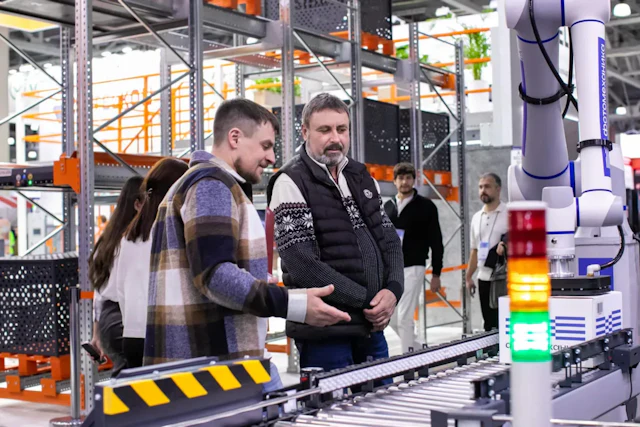
Robots in Intralogistics: Automating Order Picking
Robots automate order picking most economically where travel makes up the largest share of picking time, items are standardised and volumes stay predictable across the year. The technology exists: mobile robots assist with travel, shuttle systems bring goods to the person, and gripper robots with machine vision pick single items. Whether the investment pays back is settled by a calculation from travel share, labour cost and utilisation, and whether it works is settled by the rollout in live operations.
This article sorts the technology options by field of use, shows a payback calculation with example values and gives executives a checklist for assessing a project before the first purchase order.
Why does order picking sit at the centre of warehouse automation?
Order picking sits at the centre because in most warehouses it causes the largest share of operating cost. A widely cited literature review by de Koster, Le-Duc and Roodbergen (European Journal of Operational Research, 2007) describes the assembly of orders as the most labour-intensive and costly activity in almost every warehouse and puts its share at up to 55 per cent of warehouse operating expense. The figure is an estimate from the literature and gives an order of magnitude; the calculation further below measures the actual share in your own warehouse. Anyone who wants to cut warehouse cost starts at the pick.
Most of the time goes on travel. A picker walks to the location, searches for the item and picks it. Afterwards the picker confirms the removal and moves on. Only the pick creates value, and everything else is transport and orientation. Robots therefore start with travel. The International Federation of Robotics (IFR) reports in its World Robotics 2023 report 553,052 newly installed industrial robots in 2022, the highest figure to date. Most of them work in manufacturing, but the technology for gripping, machine vision and autonomous navigation is moving steadily into logistics.
The German guideline series VDI 3590 covers picking systems and distinguishes static from dynamic presentation of goods. In everyday usage the two principles are “person to goods” (static), where the picker walks to the storage location, and “goods to person” (dynamic), where conveyor technology brings the item to the workstation. Each robot variant either belongs to one of these principles or changes it.
Which robot technologies exist for order picking?
There are four technology variants for order picking, and they differ markedly in field of use, intrusion into warehouse operations and investment.
Mobile robots in the assistant role are the usual entry point, because they require no rebuild of the warehouse and can be expanded in stages. Shuttle systems pay off at high pick counts but tie the warehouse to the technology. Gripper robots are the youngest variant, and their maturity depends on the item range: the more uniform the items, the more dependable the pick rate. The article on AGV and AMR in the warehouse describes automated guided vehicles in detail. The standard ISO 3691-4 governs the safe operation of driverless vehicles.
When does automating order picking pay back?
Automation pays back when the annual saving in labour time exceeds the annual cost of the installation and the investment returns within the planned service life. The calculation follows four steps and can be run with your own values.
- Determine picking labour: number of full-time positions in picking times annual cost per position.
- Measure the travel share: a time study over several days, separating walking and searching from picking and confirming.
- Set the relief from the technology: which part of travel does the robot take over, evidenced by a trial in your own warehouse?
- Offset the cost: investment including integration and software against annual operating and maintenance cost over the service life.
The values are chosen to show the logic of the calculation and do not replace a measurement in your own warehouse. Two levers change the result most: the travel share and utilisation. A warehouse with short distances and low volume does not reach the threshold, whereas a warehouse with long aisles and seasonal peaks clears it by a wide margin. The assessment should also take staff availability into account: where vacancies cannot be filled, the robot takes over work that would otherwise stay undone. The article on automation against labour shortage develops this case. The article on robotics in mid-sized companies provides a basis for questions of economic viability.
Which prerequisites must a warehouse meet for picking robots?
A warehouse must meet six prerequisites for picking robots to work in daily operations. If one is missing, the risk rises of a project that convinces in the test and fails to land in operations.
In practice the interface to the warehouse management system decides how long the rollout takes, because orders and exceptions converge there. The process deserves equal attention: a robot that bundles orders by a different logic than the warehouse creates friction that eats up the saving. The same applies to collaboration between humans and machines, described in the article on cobots.
How do you roll out picking robots in live operations?
The rollout succeeds in four stages, each leaving behind an evidenced position. The warehouse keeps running throughout.
The first stage measures the current state with the metrics from the checklist. The second stage is a pilot in one zone with a limited item range and defined abort criteria, such as a target for picks per hour. The third stage extends the pilot to further zones once the metrics stay stable over several weeks. In the fourth stage regular operations take over: maintenance, fault handling, training of new staff and upkeep of master data are assigned to a role.
One mistake occurs often: the pilot runs with selected items and experienced staff and therefore delivers values that do not hold in normal operations. A dependable pilot therefore includes difficult items and peak periods. The people in the warehouse belong in the project from the start, because the robots change their work and their experience shows where the process knows exceptions that no concept foresaw.
Automating picking with Niehues Consulting
Niehues Consulting is a consultancy for AI management and organisational design from a delivery perspective, based in Düsseldorf. Niehues Consulting does not build robots and does not integrate installations. Founder Marin Niehues works on what decides the success of such a project: the business case with real values, the requirements, the rollout in operations and the roles and decision paths afterwards. He does so as delivery manager, project manager or product owner, in projects ranging from VC-funded scale-ups to DAX 40 corporations and in more than 20 countries on six continents.
The approach follows the Niehues Delivery Model with its three phases. For order picking three test questions matter most: Which business outcome should change measurably? Is the business case confirmed with real values? Who is responsible for operations from day one? The entry point is a free initial consultation of 30 minutes, which you can arrange via the contact page.
Frequently asked questions
How much does a warehouse picking robot system cost?
Costs differ considerably by technology, from staged investment in mobile assistant robots to an entirely new storage system. What counts is the installation with its integration, software and operating cost. The scope and terms of a project are discussed in the free initial consultation, and a dependable figure comes from the calculation with values from your own warehouse.
What is the payback period of picking robots?
Payback results from the annual saving, the operating cost and the investment. In the example of this article it comes to about 3.2 years. Warehouses with long distances and high pick counts reach shorter periods than warehouses with short distances and low volume.
What is the difference between person to goods and goods to person?
Under person to goods the picker walks to the storage location, under goods to person conveyor technology brings the item to the workstation. The second principle saves travel but requires its own storage system. The German guideline series VDI 3590 assigns the two principles to static and dynamic presentation of goods.
Do picking robots replace warehouse staff?
Picking robots mainly take over travel and transport, and with assistant systems the picking stays with the human. Jobs change, and tasks shift towards monitoring and fault handling. In warehouses with unfilled vacancies the robot closes a gap.
Which items can a gripper robot pick?
Gripper robots work most reliably with standardised, easily recognised items of similar shape and size. Fragile, transparent or highly varied items remain difficult. A test with your own item range shows the pick rate that can be reached.
What is the difference between an AGV and an AMR?
An AGV (automated guided vehicle) follows fixed paths such as magnetic tape or guide lines, whereas an AMR (autonomous mobile robot) navigates freely and steers around obstacles. AMRs can therefore be used without rebuilding the warehouse. Both types are used for pallet transport.
How long does it take to introduce picking robots?
The duration follows the technology and the interface to the warehouse management system. Assistant robots can be introduced in stages, while a new shuttle system needs far more lead time. A pilot in one zone delivers the first dependable metrics before the project extends to the whole warehouse.
Let’s talk about your initiative.
In 30 minutes we clarify where your organisation stands and which step will pay off most now.
Book a consultation30 minutes · free of charge · no obligation